
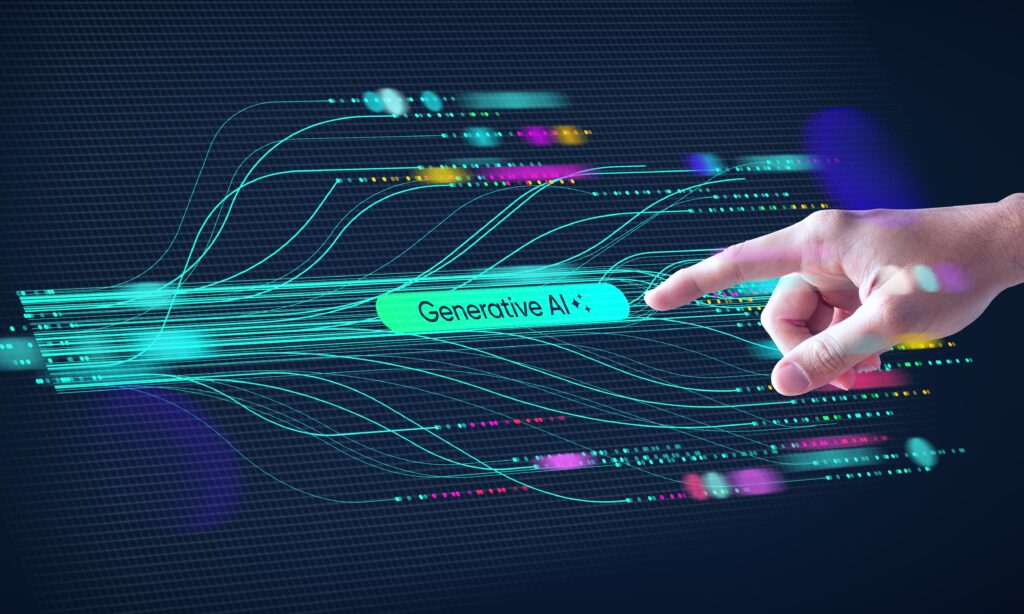
Generative AI has swept across the tech landscape, capturing headlines with ChatGPT, DALL·E, GitHub Copilot and beyond.
However, for architects and strategists, it’s not just hype — it’s a foundational technology that reshapes how we design, deliver, and govern enterprise systems.
In this guide, we’ll explore what generative AI really means, how it fits into enterprise and cloud architectures, and how you can adopt it responsibly in your organisation.
What Is Generative AI?
At its core, Generative AI refers to models that create new content — text, images, audio, video, or code — based on patterns learned from training data.
Unlike predictive models that classify or forecast, generative models synthesise new outputs.
- Generative vs Predictive AI: Predictive AI forecasts outcomes (“Will this customer churn?”); generative AI produces content (“Write an email draft”).
- Types of Generative Models:
- Large Language Models (LLMs) — Transformer-based text models (e.g., GPT, Claude, Gemini). See Azure OpenAI Service, Google Cloud Generative AI Studio, and AWS Bedrock.
- GANs (Generative Adversarial Networks) — Dual-network systems for image and video synthesis.
- VAEs (Variational Autoencoders) — Encode/decode probabilistic data representations.
- Diffusion Models — Produce high-fidelity visuals via iterative denoising.
📊 Table – Comparison of Generative Model Types
| Model Type | Full Name | Primary Output Type | Core Principle / Mechanism | Typical Use Cases | Enterprise Relevance |
|---|---|---|---|---|---|
| LLM | Large Language Model | Text, code, structured data | Transformer architecture trained on massive text corpora to predict the next token or sequence. | Chatbots, summarisation, translation, code generation | Knowledge assistants, copilots, and documentation automation |
| GAN | Generative Adversarial Network | Images, video, synthetic data | Two neural networks (generator vs discriminator) trained adversarially to produce realistic outputs | Image synthesis, video generation, data augmentation | Design automation, training data creation, and simulation |
| VAE | Variational Autoencoder | Images, audio, latent representations | Encodes input into latent space, then reconstructs from probabilistic distributions | Image denoising, anomaly detection, feature learning | Compression, feature extraction, and generative analytics |
| Diffusion Model | Denoising Diffusion Probabilistic Model | High-fidelity images, audio, 3D | Gradually removes noise from random data to generate structured output | Image and video generation (e.g. DALL·E, Stable Diffusion) | Creative design, visualisation, and digital twin modelling |
Each has trade-offs around quality, interpretability, and cost — but all share one theme: creating new value from existing data.
Why Generative AI Matters for Architects & Strategists
For enterprise and solution architects, generative AI bridges the gap between creativity and system design.
It can transform the way we build, document, and automate architectures.
Business Value
- Automate repetitive documentation and reporting.
- Generate architecture diagrams, scenarios, and roadmaps to support effective planning and decision-making.
- Enable AI copilots for system operations or user support.
- Accelerate ideation and design through content or code generation.
Key Use Cases
- Enterprise chat assistants and copilots.
- Intelligent document summarisation and policy drafting.
- Code or query generation for developers and data teams.
- Design automation (e.g., sketch-to-architecture concepts).
If you’re exploring how generative AI aligns with traditional frameworks, see Enterprise Architecture Foundations.
Risks & Constraints
- Hallucinations: Models may generate inaccurate content.
- Bias: Training data reflects human bias.
- Compliance: Possible IP or data privacy violations.
- Cost: High inference and compute requirements.
- Governance: The Need for Explainability and Control.
Core Components of Enterprise Generative AI Architecture
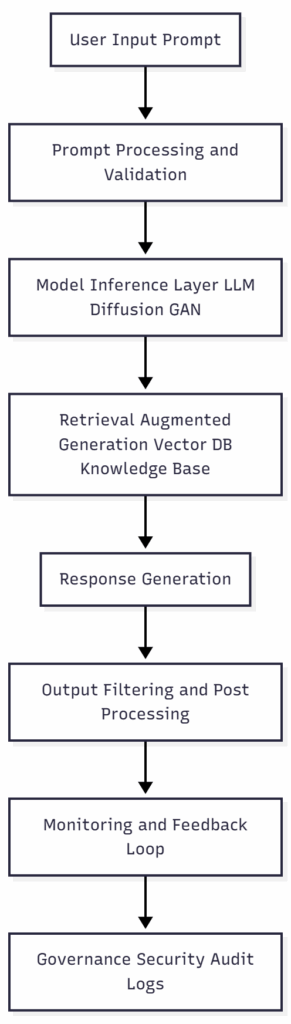
To move from concept to production, architects must consider the entire stack — from data to governance.
Inputs & Prompt Design
Structured prompts and templates define model behaviour. Add guardrails, context injection, and validation to ensure consistency and reliability.
Model / Inference Layer
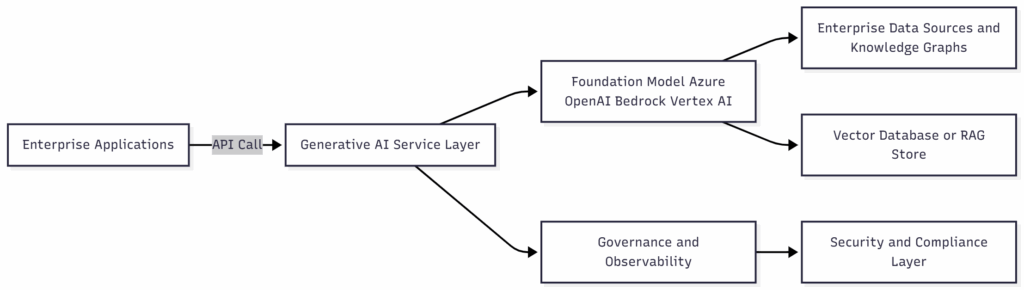
Your foundation model — hosted via Azure OpenAI, Vertex AI, or AWS Bedrock — performs generation.
Architects often add adapters or fine-tuning layers for domain-specific use.
Data & Knowledge Layer
- Retrieval-augmented generation (RAG) using vector databases (Pinecone, Azure AI Search, Amazon Kendra, Google Vertex Vector Search).
- Document chunking and embeddings.
- Data governance and lineage tracking.
Orchestration & Agent Frameworks
Frameworks like Azure Semantic Kernel, LangChain, and Google LangServe facilitate the coordination of tasks and reasoning chains, enabling seamless integration of AI capabilities.
Monitoring & Observability
Track accuracy, latency, and drift. Use feedback loops to improve outputs.
Governance, Security & Compliance
- RBAC, audit logs, and policy enforcement.
- Content moderation and filtering.
- Transparent model sourcing and explainability.
Integrating Generative AI into Cloud & Enterprise Architectures
Architecturally, generative AI sits between the data and application layers, acting as an intelligent middle tier.
- Integrate via APIs, microservices, or serverless functions.
- Securely connect to enterprise data sources.
- Extend cloud landing zones to include AI workloads, vector stores, and model registries.
- Reuse TOGAF and CAF principles for governance and traceability.
For more depth, see: What is TOGAF? 10 Powerful Facts You Must Know in 2025
Generative AI in Enterprise Architecture Practice
Enterprise Architects play a dual role — AI users and AI enablers.
- Use generative AI to automate documentation and simulate future scenarios.
- Define platform standards and governance to support the safe adoption of GenAI.
- Align AI initiatives with enterprise principles and data sovereignty requirements to ensure compliance.
For framework alignment, explore The Open Group TOGAF Standard.
Best Practices & Design Principles
1. Start Small and Iterate — Begin with low-risk use cases.
2. Use Retrieval & Grounding — Link models to trusted enterprise data.
3. Modularise & Version — Maintain precise lifecycle control.
4. Observe Everything — Dashboards and feedback loops.
5. Govern from Day One — Security, compliance, audit.
6. Collaborate Cross-Functionally — Architects, ML, security, and legal.
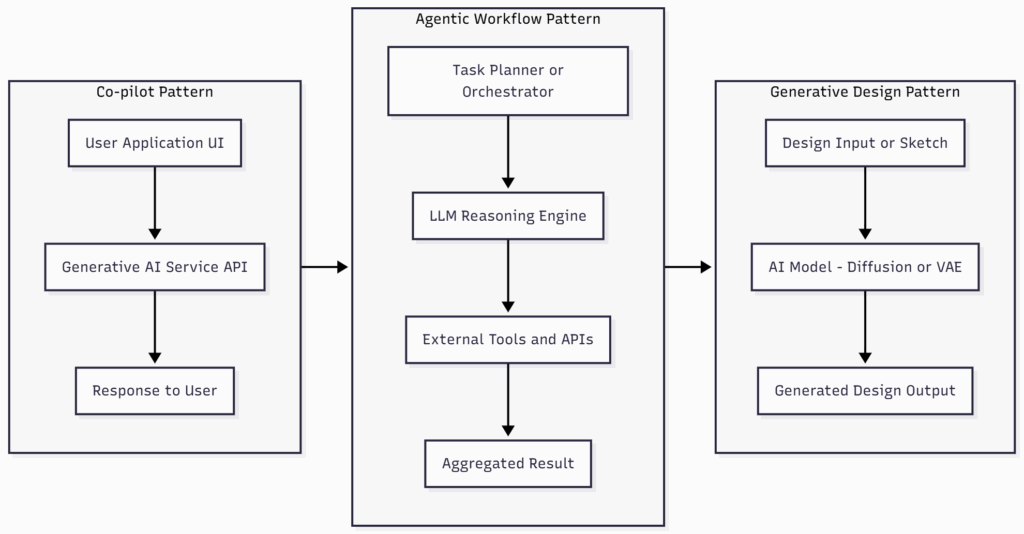
Example Architecture Scenarios / Patterns
- Document Assistant / Copilot: Summarises and generates content within enterprise systems.
- Content-Generation Microservice: Produces reports or marketing material on demand.
- Agentic Workflow: Orchestrates multiple AI calls with memory and reasoning.
- Generative Design: Sketch-to-floorplan systems for ideation.
Steps to Adopt Generative AI in Your Organisation
- Assess Readiness — Evaluate infrastructure and skills.
- Identify Use Cases — Target high ROI, low risk.
- Build a Prototype — Integrate model APIs and observe metrics.
- Scale Through Platformization — Centralise prompt and vector management.
- Govern and Measure ROI — Monitor KPIs and ensure responsible AI compliance.

Conclusion & Next Steps
Generative AI is more than automation — it’s a new architectural paradigm.
It enables systems that reason, adapt, and co-create.
Key Takeaways
- Generative AI creates new content rather than predicting outcomes.
- Effective adoption requires an end-to-end architecture stack.
- Enterprise Architects ensure safe, governed, and scalable AI deployment.
Next Steps
- Choose one internal pilot use case.
- Sketch a minimal viable GenAI architecture.
- Review frameworks like TOGAF and Microsoft CAF.
- Iterate and scale responsibly using cloud AI platforms from Azure, AWS, or Google Cloud.
📚 Related Reading
- What is TOGAF? A Beginner’s Guide to the Open Group Architecture Framework
- Getting Started with ArchiMate: The Modelling Language for Enterprise Architecture
- Understanding Cloud Landing Zones for Enterprise Architects
Stay tuned for upcoming articles on AI governance, AI reference architectures, and enterprise AI operating models.
✅ External Link Summary
| Topic | Clean Authoritative Source |
|---|---|
| Microsoft Generative AI Platform | Azure OpenAI Service |
| Google Generative AI Platform | Google Cloud Generative AI Studio |
| AWS Generative AI Platform | Amazon Bedrock |
| EA Framework | The Open Group TOGAF Standard |