The Solution Architecture Framework (SolAF) defines how strategy connects with technology — turning vision into executable design.
In today’s fast-evolving world of cloud computing, data platforms, and AI-driven services, architects must strike a balance between governance and agility. Traditional frameworks like TOGAF and Microsoft CAF provide structure, but they often function in isolation.
That’s where the framework comes in — a modern architecture model designed to unify established practices into a single, practical approach.
Introducing SolAF: A Modern Solution Architecture Framework for the Cloud, Data, and AI Era 1
SolAF™ and its associated models, diagrams, and documentation are the original intellectual property of Sarath Boppudi.
SolAF is a meta-framework that combines the strengths of TOGAF, ArchiMate, Zachman, and Microsoft CAF into a unified model.
It provides a structured yet flexible methodology for architects to create consistent, traceable designs that align business intent with cloud execution.
SolAF helps teams deliver solutions that are strategic, scalable, and future-ready.
Introducing SolAF: A Modern Solution Architecture Framework for the Cloud, Data, and AI Era 2
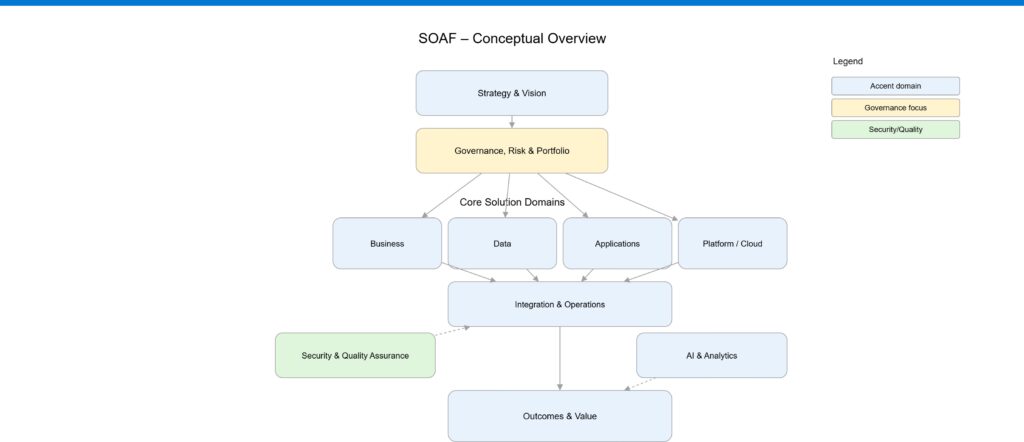
(Placeholder image: “SolAF conceptual overview diagram” — Alt text: “SolAF framework connecting business, data, application, and technology layers.”)
2. Why I Built SolAF?
Over years of consulting across industries, I noticed a persistent issue — architects struggled to balance rigour and delivery speed.
SolAF was created to bridge that gap. It integrates governance, design, and execution into one coherent architecture approach. Rather than replacing traditional methods, SolAF organises and aligns them — ensuring traceability across business, data, application, and technology domains.
3. What Makes SolAF Unique
✅ Integrated Design Model – Combines TOGAF’s governance, ArchiMate’s modelling, and CAF’s cloud focus. ✅ Visual & Practical – Built on clean, reusable diagrams for conceptual, logical, and physical layers. ✅ Grounded in Reality – Based on real-world architecture delivery experience. ✅ Cloud & AI Ready – Supports Azure Landing Zones, data pipelines, and intelligent systems. ✅ Cross-Domain Traceability – Links business strategy to technical design seamlessly.
Employing SolAF ensures the following:
Data management processes are robust
Teams can achieve more coherent outcomes
Organisations and solutions can meet regulatory compliance
Teams can innovate faster
Can adapt to various project sizes and complexities.
Enhanced Collaboration
Offers a clear pathway for teams to follow
Can significantly improve project outcomes.
Leads to better alignment between business and technology.
Ensures that all technology decisions align with strategic goals.
Principle: Clarity, Consistency, and Connectedness in every design layer.
4. Inside the Framework
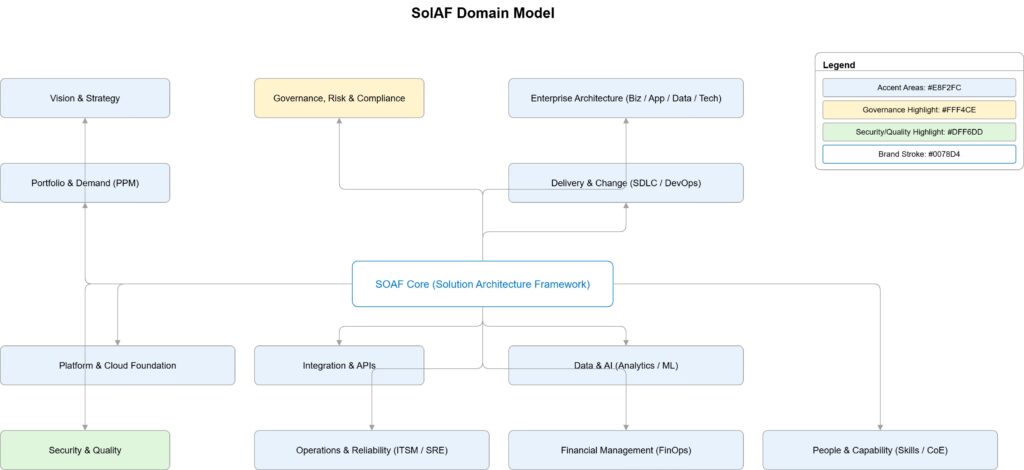
SolAF is structured into six interconnected domains representing the end-to-end architecture lifecycle:
Business & Strategy – Defines drivers, objectives, and capabilities.
Information & Data – Structures data flow, ownership, and governance.
Application – Describes services, APIs, and integrations.
Technology – Covers infrastructure, platforms, and deployment topologies.
Governance & Compliance – Embeds policies, risk controls, and security.
AI & Intelligence – Enables insights and automation across the ecosystem
SolAF domain model diagram
5. The SolAF v1.0 Book
The upcoming SolAF v1.0 Guide will take these ideas further. It includes:
Over 20 detailed architecture diagrams
Real-world examples from Azure and GCP
Governance and risk models
Templates for capability maps and interaction matrices
Introducing SolAF: A Modern Solution Architecture Framework for the Cloud, Data, and AI Era 3
The book’s mission is simple: help architects design with clarity, consistency, and confidence.
Who Benefits
Whether you’re an Enterprise Architect, Solution Designer, or Data & AI Specialist, SolAF offers:
A consistent and repeatable design process
Clear traceability from business goals to implementation
A unified vocabulary for cross-domain collaboration
SolAF enhances your current toolkit — not replaces it.
What’s Next
SolAF continues to evolve through ongoing client engagements and community input. Upcoming milestones:
Architecture frameworks should empower, not complicate. SolAF exists to give architects a coherent and adaptable model for the Cloud, Data, and AI era — bridging strategy, governance, and delivery into one narrative.
“Architecture should evolve with technology — not remain constrained by it.”
Join me in shaping the next generation of architectural practice.
📣 Call-to-Action
🔗 Follow the Journey:LinkedIn | Twitter | BlueSky 📰 Subscribe: Be the first to know when the SolAF v1.0 Book launches. 💬 Comment Below: What’s your biggest challenge designing architectures in the cloud and AI era?
🔗 Internal Links
Understanding and utilising an architecture framework is vital for modern architecture and fosters a culture of strategic thinking.
To provide the best experiences, we use technologies like cookies to store and/or access device information. Consenting to these technologies will allow us to process data such as browsing behavior or unique IDs on this site. Not consenting or withdrawing consent, may adversely affect certain features and functions.
Functional
Always active
The technical storage or access is strictly necessary for the legitimate purpose of enabling the use of a specific service explicitly requested by the subscriber or user, or for the sole purpose of carrying out the transmission of a communication over an electronic communications network.
Preferences
The technical storage or access is necessary for the legitimate purpose of storing preferences that are not requested by the subscriber or user.
Statistics
The technical storage or access that is used exclusively for statistical purposes.The technical storage or access that is used exclusively for anonymous statistical purposes. Without a subpoena, voluntary compliance on the part of your Internet Service Provider, or additional records from a third party, information stored or retrieved for this purpose alone cannot usually be used to identify you.
Marketing
The technical storage or access is required to create user profiles to send advertising, or to track the user on a website or across several websites for similar marketing purposes.